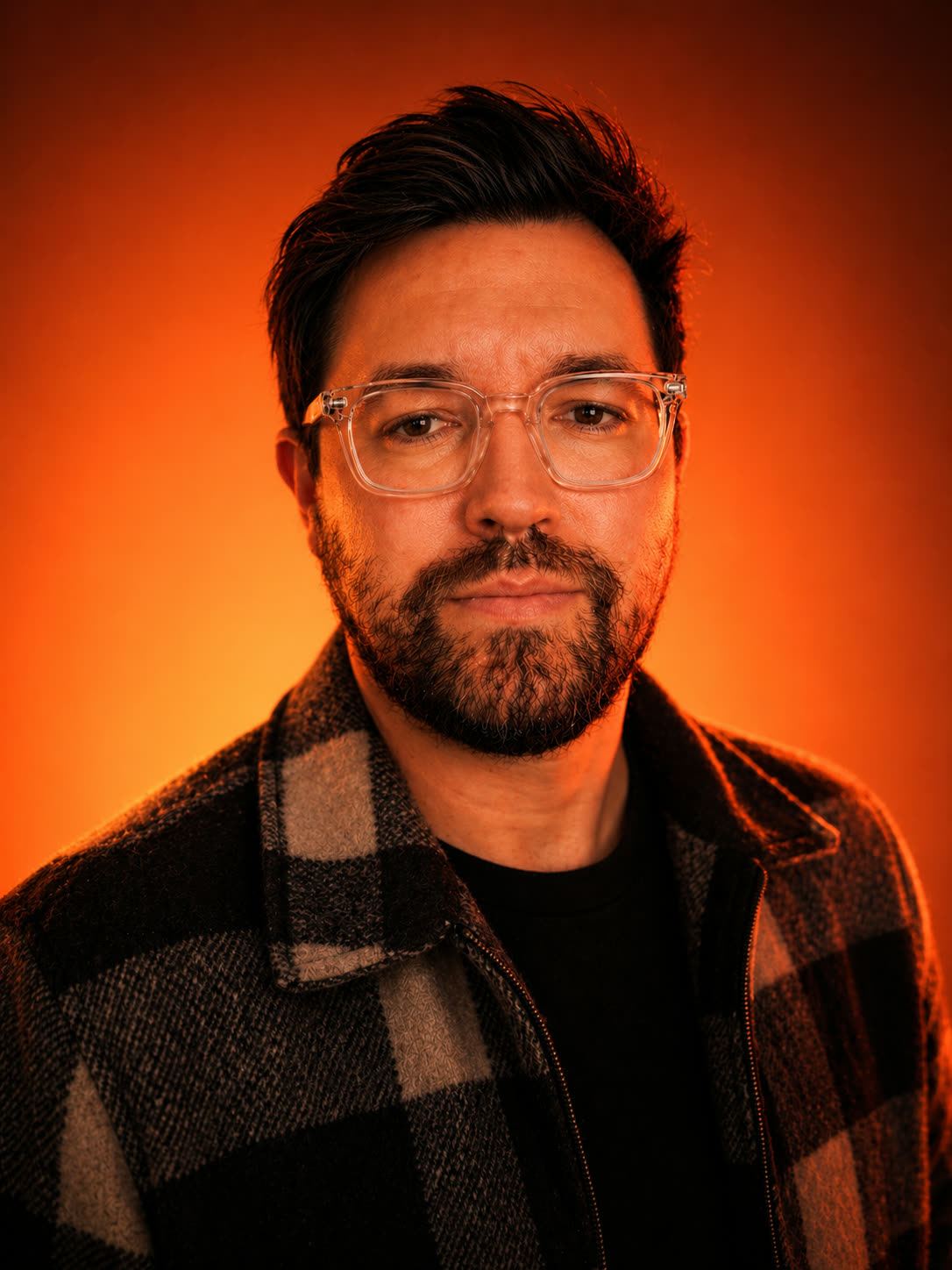
 Elliot Rylands
I Design for Carers. I Couldn't Let Anyone Care for Me.
I work for a company that helps carers care. Then a seizure made me the one who needed care, and I lied about it to everyone to avoid the panic.
I work for a company whose entire reason for existing is helping carers care. That is the job. I spend my working hours thinking about the people who hold other people up: how to lighten what they carry, how to design for someone running on empty at 2am, how to make asking for help feel less like defeat.
Then I had a seizure, and for the first time in my life I was the one who needed the care. And I discovered that everything I understood about care from the giving side, professionally and personally, had taught me almost nothing about how to receive it. I was so bad at receiving it, in fact, that I lied. To my colleagues, to my friends, to my family. To more or less everyone.
Somewhere among the people I know, there is still a version of my seizure story where I brought it on myself. A version with drinking in it, or some flavor of recklessness that makes a seizure feel explainable and, better yet, avoidable. Nobody has ever said this version to my face. It lives in pauses, in carefully phrased questions, in the slight distance that opened up with certain people afterward. I have known about it almost from the start, and I have never once corrected it.
This post is the correction.
Three days without sleep
Before the seizure, I had not slept for three days. Not three days of bad sleep. Three days of essentially nothing, and for no reason I could name. I would lie down exhausted and my brain would refuse to power down. No racing thoughts I could point at, no obvious trigger. Just a switch that would not flip.
There was context, though, even if I could not see it from inside. We were in the middle of emigrating, and if you have never done that, it is hard to describe how completely it takes over your head. Every part of your life becomes conditional. Schools, careers, friendships, which country your future actually lives in: all of it pending, all of it out of your hands. A doctor would later put it in plain terms. My stress levels were dangerously high, and the uncertainty of the move was the engine behind them.
By the third day without sleep I was hallucinating. I am not going to dress that up or make it cinematic. Sleep deprivation at that level starts to dissolve the line between what is there and what is not, and mine had started to dissolve.
Here is the part I keep coming back to. I knew something was badly wrong, and my response was to hide it and push through. I had a team at work relying on me, and I wanted to show up for them properly. I had a family that needed a dad who was present and okay. So I did what a lot of us have been quietly trained to do: I poured caffeine on top of a malfunctioning brain and performed being fine. Meetings. Feedback. Home by dinner. More coffee. I treated my own nervous system like a staging server that could be kept alive with hacks until things calmed down.
The irony was already in full swing by then, if I had been in any state to notice it. I spent my days building for people who burn themselves out looking after others, while burning myself out and refusing to be looked after. My body eventually ended the performance for me. I had a seizure.
"We're not sure" is a story people finish for you
I cannot give you a clean account of the seizure itself. Some of that is by choice. Most of it is that the memories are simply not there. What I can tell you is what came after: hospital, monitoring, tests, and a long stretch of medical shrugging. Nobody could say definitively why it happened. Severe sleep deprivation and extreme stress were the obvious suspects, but for a very long time nobody would sign their name to a single cause.
So when people asked, I told them the thing that was technically true. "We're not sure what happened."
I want to be precise here, because this matters. I never lied outright. I said "we're not sure" and let it hang. But "we're not sure" is a vacuum, and people cannot leave a vacuum alone. They finish the story with whatever material they have, and the material most people have about seizures in otherwise healthy adults comes from movies and gossip. The story they finished was that I had been drinking. Maybe worse.
I could have killed that rumor with one sentence. "I had not slept in three days and my brain gave out." One sentence. I have had so many chances to say it, in kitchens, on calls, in quiet one-on-ones where the question almost surfaced. I never said it. I watched people believe something false about me, something that made me look reckless instead of unwell, and I decided, over and over, that the false version was safer.
The first time I was the one who needed care
Here is what nobody tells you about being on the receiving end for the first time in your life: it feels like a demotion.
I had never needed care before. Not really. I had been the steady one, the one who shows up, the dad, the colleague you hand things to when they are on fire. My whole identity, at home and at work, was built on being load-bearing. And then one day I was a person other people had to watch. A person with appointments, and monitoring, and a question mark where his health used to be. People wanted to drive me places. People checked in with that new, careful voice.
I could not stand it.
The professional irony made it worse, because I did not even have ignorance as an excuse. I work in care. I knew the language. I had absorbed all of it in the context of the carers we build for: how the people they look after often resist help, hide symptoms, downplay bad days, protect their families from the truth of their condition. I had nodded along to all of it. Then I became that exact person within days of needing care myself, and every one of those behaviors turned out to live in me, fully formed, waiting.
If you had asked me at the time why I kept quiet, I would have given you a noble-sounding answer. I did not want to cause panic. My family was mid-emigration and did not need another thing to fear. My colleagues did not need to wonder, mid-project, whether I was about to go down again. My kids did not need to be scared of their dad's brain. "We're not sure" kept everyone calm. Telling the whole truth felt like handing my fear to the people I love and asking them to carry it for me.
There is something real in that. When your health fails in a frightening way, you are suddenly managing two problems: the illness, and everyone's feelings about the illness. Other people's worry needs feeding and soothing. Some days the illness was the easier of the two jobs.
But if I am doing the full honesty thing, that is only half the ledger. I told myself the lie was for them. A lot of it was for me. I was afraid of being treated differently, and I still am, even as I type this. I work with my brain. Design and engineering are the whole of what I sell: judgment, memory, pattern recognition, the ability to hold a system in my head while I change one part of it. The moment people know that doctors are monitoring that brain, I assumed every normal mistake would get reread as a symptom. Miss a detail in a review? He is not what he was. Blank on a name? There it is again.
So the drinking rumor, in a bleak way, worked for me. Reckless is temporary. People forgive a wild night, and they mostly forget it. What I feared they would never forget was the suggestion that something in me might be permanently unreliable. I chose to be thought irresponsible rather than fragile. I am not recommending that trade. I am telling you I made it, and kept remaking it, quietly, for a long time.
What the silence actually cost
Start with the cost I can measure least and feel most: memory. The seizure, or the state that produced it, took a real piece of my memory and has not given it back. This is not vague fogginess. These are losses I notice, and that I suspect people around me notice too, which is its own particular fear. When you are hiding the cause, you also have to hide the damage, and the damage does not always cooperate. Every gap becomes a small performance. Cover, deflect, joke, move on.
Then there is the diagnosis that took forever to arrive at anything. I am still monitored. For a long time the word circling overhead was epilepsy, and it was the one that scared me most, because it would convert "a thing that happened to me" into "a thing I have." I can finally say that so far there are no signs of it, and there has been no recurrence. That sentence took a long time and a lot of appointments to earn, and I do not take it for granted. But I spent the whole in-between period, tested but not resolved, essentially alone with it. Secrecy makes a waiting room lonelier than it needs to be. Nobody can sit with you in a room they do not know exists.
The silence cost me support in a hundred small ways. Friends who would have shown up were never given the chance. Colleagues who might have quietly covered for me on the hard weeks were instead left with the rumor version. And here is the one that stings most, given where I work: I denied the people around me the chance to be carers. I know, better than most, what caring for someone actually gives the carer. Purpose, closeness, the sense of being trusted with something that matters. I preach that five days a week. And when it was my turn to be cared for, I locked the door.
Being cared for is a skill, and nobody teaches it
So, plainly, for the record: I had a seizure. It was not drinking. I had not slept for three days, I was hallucinating, my stress levels were somewhere in the stratosphere from emigrating, and I hid all of that and kept working and caffeinating until my brain forcibly shut the whole operation down. The cause stayed unclear for a very long time. I am still monitored, epilepsy has so far shown no signs, there has been no second seizure, and my memory has holes in it that have not filled back in. That is the whole truth, said in public, for the first time.
I do not have a tidy redemption arc. Publishing this scares me for exactly the reasons that kept me quiet. Some of the people reading it work with me, and I cannot control what they do with it. But I have run the other experiment for long enough to report the results. Protecting everyone from the truth did not protect me from anything. It just meant I went through the most frightening stretch of my life alone, while wearing a story that was never mine.
What the whole thing left me with is this. We talk about care as if the hard part is giving it. Whole industries, including mine, exist to support the giving side, and they should. But receiving care is its own skill, and nobody teaches it, and some of us arrive at our first real health crisis in our thirties or forties having never once practiced. Letting someone drive you to an appointment. Letting your team see you at less than full strength. Letting your family worry about the real thing instead of a sanitized one. Worry is one of the ways people love you. I spent a long time intercepting it.
If you are living inside your own version of this, hiding a scare or a diagnosis because the people around you seem calmer not knowing, I will not tell you that you owe anyone full transparency. You do not. Your medical story is yours. But watch the ledger. Every week the silence buys calm, it charges interest, and the interest compounds in isolation. Three days without sleep taught me what my limits sound like when they stop asking politely. Learning to be cared for is taking a lot longer. This post is me practicing.